Junior Eurovision 2020 | Final decision on Junior Eurovision participation to be made on September 7th
Junior Eurovision 2020 | Final decision on Junior Eurovision participation to be made on September 7th
Junior Eurovision 2020 | Final decision on Junior Eurovision participation to be made on September 7th
Last April, fans of the Eurovision Song Contest were left reeling as rumours of a cancellation of the 2020 contest culminated in a heartfelt final cancellation in a poignant video from Jon Ola Sand, the then Executive Producer of the Eurovision Song Contest at the European Broadcasting Union.
In May, our spirits were lifted as Eurovision: Europe Shine a Light paid tribute to the artists and songs of the Eurovision that never was. However, many fans have still been left wanting more.
The good news is, it is full steam ahead for the Junior Eurovision Song Contest 2020 which will be broadcast from Warsaw, Poland on November 29th 2020, with contestants participating from studios in their own countries. This will be the 18th Edition of the Junior Eurovision.
There is likely to be more attention on the Junior edition this year than ever before with many Eurovision fans set to tune in for the first time to quench their Eurovision thirst. To help bring you up to speed, Eurovoxx presents: The Beginners Guide to the Junior Eurovision Song Contest!
In the beginning...
The Junior Eurovision Song Contest has its origins in a Scandanavian format that emerged in 2002. Melodi Grand Prix Nordic 2002 was open to children aged 8-15 years and included Denmark, Norway and Sweden. In fact, this format was itself a spin off from a children’s version of the Danish national final: De Unges Melodi Grand Prix, which ran within Denmark alone for the two years before the Nordic version began.
In the run up to the first Junior Eurovision in 2003, the European Broadcasting Union picked on the MGP Nordic format with a view to opening it to EBU members across the continent. With that, plans were afoot for the first edition, with Denmark as hosts, given their experience to date with a junior context.

The First Show!
The first Junior Eurovision Song Contest took place in Copenhagen, Denmark on November 15th 2003. Entries were received from 16 countries, including Belarus, who had not even competed in the adult version by that time.
11 year old Dino Jelusić clinched the first Junior Eurovision victory with a 9 point lead over the runner up from Spain, with his song “Ti si moja prva ljubav” (You are my first love).
It had already been decided that the winning country would not automatically be given the right to host the contest the next year. This had been decided in order to reduce pressure on the young contestants. Instead countries could bid to host the contest. The first contest was a success, but what next?
Teething Problems
The second contest was plagued by location issues. Originally British Broadcaster ITV had been working towards hosting the 2004 contest in the city of Manchester. However, the project was abandoned due to financial and scheduling issues. The Croatian broadcaster HRT was then approached to stage the event. This arrangement fell through when it emerged that the Croatian broadcaster were unable to secure their intended venue due to unavailability.
It was then, with 5 months to go, Norwegian broadcaster NRK swept int to host the contest in Lillehammer, a ski resort town in Southern Norway.
From then on it was decided that broadcasters would have to bid for the rights to host the contest. Belgium was therefore the first country to successfully bid for the rights to host the contest in 2005 when it came to the city of Hasselt.
The Scandinvian departure
In 2006 the contest hit another speedbump when the founding countries decided to withdraw from the Junior Eurovision and revert back to their original MGP Nordic format. At the time it was reported that the Scandinavian broadcasters were unhappy with the amount of commercial pressure placed on the young contestants in the final, and found the treatment of the contestants unethical. Another factor may have been that, beginning in 2007, a rule change meant that participants were allowed to enter even if they had previously released music commercially. Prior to that, contestants had to have no previous commercial releases.
MGP Nordic continued until 2009 until it’s cancellation in 2010. Since then Sweden participated intermittently in the Junior Eurovision, but Norway and Denmark have never returned.
In general, participation in the contest changes from year to year. Only Belarus and The Netherlands have participated in every Junior Eurovision to date.
A rollercoaster of a ride
Although the contest got off to a good start, it didn’t always stay that way. As the years went by, it appeared that the contest was losing some of its popularity, and we saw fewer countries wanting to participate, so much so that in 2012 and 2013, we saw the lowest number of participating countries in Junior Eurovision: 12. However, in 2014, the numbers started to pick up again with 16 countries taking to the stage in Malta. Since then, the popularity of the contest has continued to go from strength to strength, even seeing a record number of 20 participants in 2018!
Participating Countries
39 countries have competed in the Junior Eurovision at least once. Listed below are all the countries that have ever taken part in the competition alongside the year in which they made their debut. The highest number of participants was in 2018 with 20 countries.
Georgia has won the Junior Eurovision Song Contest a record 3 times in total (2008, 2011, 2016); with Poland, Belarus, Russia and Malta having two wins each.
Armenia has the strongest overall record with seven top 3 finishes. Armenia has never been outside the top 10.
The Netherlands, Ukraine, Malta and Belarus (and soon Poland) have hosted the Junior Eurovision Song Contest on more than one occasion.
Year | Country making its debut entry |
2003 | Belarus |
| Belgium |
| Croatia |
| Cyprus |
| Denmark |
| Greece |
| Latvia |
| Malta |
| Netherlands |
| North Macedonia |
| Norway |
| Poland |
| Romania |
| Spain |
| Sweden |
| United Kingdom |
2004 | France |
| Switzerland |
2005 | Russia |
| Serbia and Montenegro |
2006 | Portugal |
| Serbia |
| Ukraine |
2007 | Armenia |
| Bulgaria |
| Georgia |
| Lithuania |
2010 | Moldova |
2012 | Albania |
| Azerbaijan |
| Israel |
2013 | San Marino |
2014 | Italy |
| Montenegro |
| Slovenia |
2015 | Australia |
| Ireland |
2018 | Kazakhstan |
| Wales |
2020 | Germany |
Junior Stars Graduate to the Senior Competition
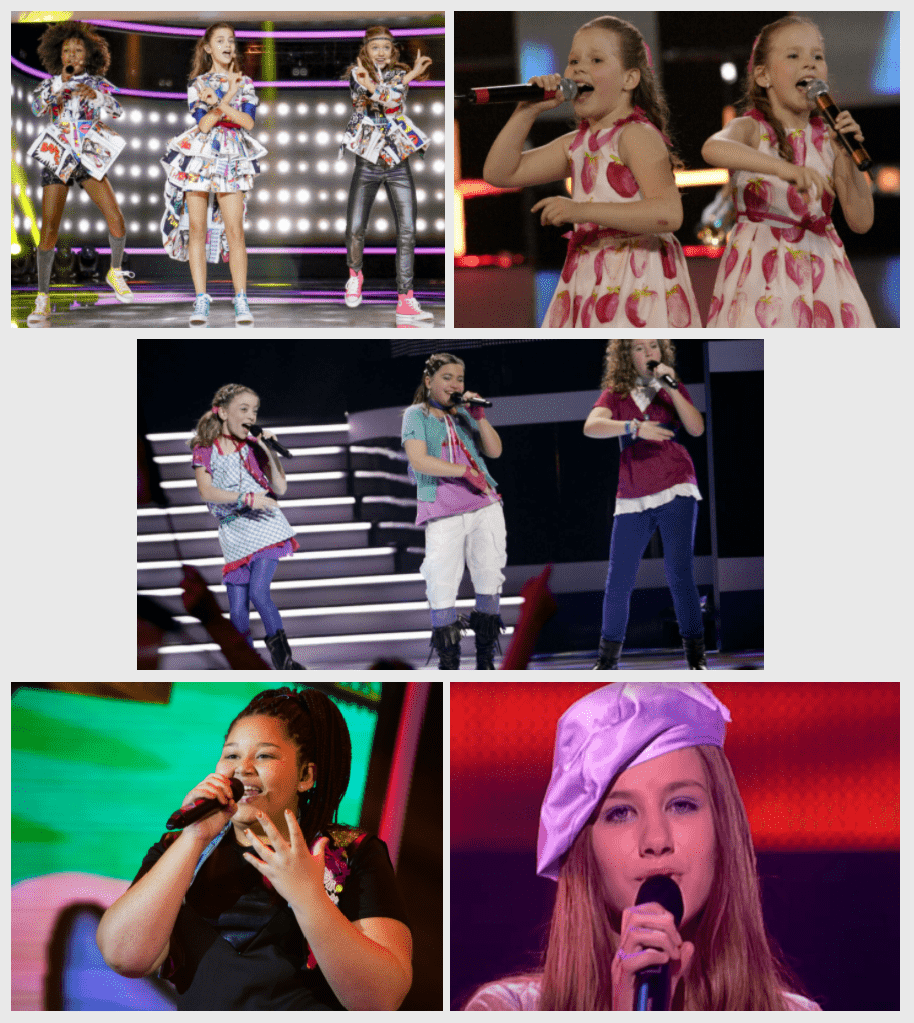
Since the first Junior Eurovision Song Contest, several Junior participants, including former winners, have gone on to perform at the Eurovision Song Contest. See if you can find some familiar faces in the photos below!
To see more, see our article: Eurovision can be addictive! Artists who participated in Junior Eurovision and Eurovision.
Unique Rules
Junior Eurovision is broadly based on the concept of its older sibling, but there are some noteworthy differences.
- The main vocals for a performance must be sung live, however backing vocals are permitted on the backing track. The EBU announced in June 2020 that this rule would be trialled for one year in the adult contest in 2021.
- From 2003-2007, a maximum of 8 performers were allowed on stage, rather than the maximum of 6 in the adult contest. But this was reduced to 6 from 2008 onwards.
- From 2005 to 2015, every country was automatically awarded 12 points just before the voting begun, so that no contestant would receive zero points.
- The voting itself has undergone a few changes over the years. From 2003-2013, the results were decided by 100% televoting. In 2014, juries were brought in and there was 50% televoting, 50% jury voting. Online voting was first introduced in 2017 and has stayed ever since. And in 2016, for one year only, they had only jury voting (adult jury and kids jury) alongside an expert panel voting. (The expert panel was made up of Christer Björkman, Jedward (Ireland 2011 & 2012) and Mads Grimstad, an opera singer from Denmark.
- All songs must written and sung in at least 60% of the national language, with up to 40% being allowed in English or any other language.
- Over the years the permitted age range has changed from 8-15 to 10-15, and now currently stands at 9-14 years.
- Since 2008, adults have been allowed to assist in the writing of entries. Previously, all writers had to be aged 10 to 15, and they had to be present on stage during the performance in the grand final.
Previous Winners
Year | Host country | Number of entries | Winner | Song | Performer |
2003 | Denmark | 16 | Croatia | “Ti si moja prva ljubav” | Dino Jelusić |
2004 | Norway | 18 | Spain | “Antes muerta que sencilla” | María Isabel |
2005 | Belgium | 16 | Belarus | “My vmeste” (Мы вместе) | Ksenia Sitnik |
2006 | Romania | 15 | Russia | “Vesenniy Jazz” (Весенний джаз) | Tolmachevy Sisters |
2007 | Netherlands | 17 | Belarus | “S druz’yami” (С друзьями) | Alexey Zhigalkovich |
2008 | Cyprus | 15 | Georgia | “Bzz..” | Bzikebi |
2009 | Ukraine | 13 | Netherlands | “Click Clack” | Ralf Mackenbach |
2010 | Belarus | 14 | Armenia | “Mama” (Մամա) | Vladimir Arzumanyan |
2011 | Armenia | 13 | Georgia | “Candy Music” | CANDY |
2012 | Netherlands | 12 | Ukraine | “Nebo” (Небо) | Anastasiya Petryk |
2013 | Ukraine | 12 | Malta | “The Start” | Gaia Cauchi |
2014 | Malta | 16 | Italy | “Tu primo grande amore” | Vincenzo Cantiello |
2015 | Bulgaria | 17 | Malta | “Not My Soul” | Destiny Chukunyere |
2016 | Malta | 17 | Georgia | “Mzeo” (მზეო) | Mariam Mamadashvili |
2017 | Georgia | 16 | Russia | “Wings” | Polina Bogusevich |
2018 | Belarus | 20 | Poland | “Anyone I Want to Be” | Roksana Węgiel |
2019 | Poland | 19 | Poland | “Superhero” | Viki Gabor |
The Junior Eurovision Song Contest 2020
Following the cancellation of the Eurovision Song Contest 2020 due the COVID-19 pandemic, work on Junior Eurovision 2020 was suspended. However, on 16 May 2020, during the airing of Eurovision: Europe Shine a Light, it was confirmed that the contest would go ahead.
Junior Eurovision Song Contest 2020, in association with Telewizja Polska and the EBU will take place on November 29th 2020. 13 countries so far have confirmed their participation, but notable withdrawals include Ireland, Serbia and Wales, citing concerns over the ongoing coronavirus pandemic.
Check out our Junior Eurovision 2020 Song Reactions on YouTube! Let’s get ready to #MoveTheWorld in Poland!